AI and Satellite Data: The New Backbone of Climate Intelligence Platforms
In a world where climate change has started showing its real impacts, data has become the lifeblood for well-informed discourse and decision-making. From tracking greenhouse gas emissions to modeling future climate scenarios, the AI-satellite data combination is turning out to be the new backbone of climate intelligence platforms.
At C3S UK, we leverage this powerful combination to provide highly actionable and science-led insights. With our climate intelligence platforms, organizations can navigate the rather complex fields of sustainability, resilience, and net-zero planning.
The Climate Data Revolution: Turning Raw Observations into Actionable Insights
Satellite systems that orbit our sphere are providing observations of our planet in an uninterrupted stream. It is from atmospheric composition to changes in land and ocean surfaces.
Traditionally, this raw data from satellite imagery was manually analyzed and interpreted. Thus, impeding its relevance for timely climate assessment. Now, by AI-based climate analytics, this massive volume of satellite observations can be processed in minutes and converted into clear and structured climate information that informs critical decisions.
The powerful state-of-the-art machine learning models are capable of flagging any patterns, trends, and anomalies that would otherwise escape unnoticed. These insights flow directly into climate risk models, emission tracking systems, and adaptation planning tools, thus reducing the gap between data accumulation and meaningful action.
Why Is Satellite Data Essential for Climate Intelligence?
The satellites reinforce a remarkable degree of vantage point with global accessibility. Satellite platforms, contrary to ground sensors limited to a specific location, provide global coverage for climate scientists to examine:
- Greenhouse gas concentration in the atmosphere.
- Changes in temperature around the globe.
- Health of vegetation and land cover changes.
- Sea-surface temperatures and the dynamics of ice sheets.
Such an extensive view of the world provides great models for the changes in climate and also monitors long-term trends for which policies and strategies of different corporations can be framed.
In addition, climate satellite data will be directed to open, trustworthy repositories. At C3S, we compile observations with high-end modeling in order to dispense authoritative climate data for the public, researchers, and industry.
AI: Enhancing Insight, Speed, and Precision
Climate artificial intelligence greatly increases the value of satellite data by automating complicated analytical tasks. The modern AI systems, for example, can:
- Detects subtle environment changes over time.
- Forecast future climate change scenarios with enhanced precision.
- Improve anomaly detection for early warning systems.
- Integrate multiple streams of data into a coherent layer of intelligence.
All these lead to significant reductions in time from data collection to insight generation, which is what organizations wish to do: build resilience in their services or reduce their carbon footprint. AI does not simply hasten insights; it enhances them.
Machine learning models can explore patterns in historical data and cross-link inputs from multiple sources to recognize patterns that traditional climate models perhaps overlook- an effort targeting the possibility of developing richer climate risk assessments and more impactful emissions tracking across sectors.
AI and Satellite Data in Practice: Real-World Climate Intelligence
At C3S, we use the dual power of AI and geospatial data to provide bespoke solutions in climate intelligence. With these geospatial and AI for climate intelligence services, organisations can decode complex climate trends and environmental changes, enabling them to make more intelligent decisions towards sustainability.
For example, using our predictive models based on artificial intelligence, we can query satellite-derived datasets nearly in real time to perform such tasks as:-
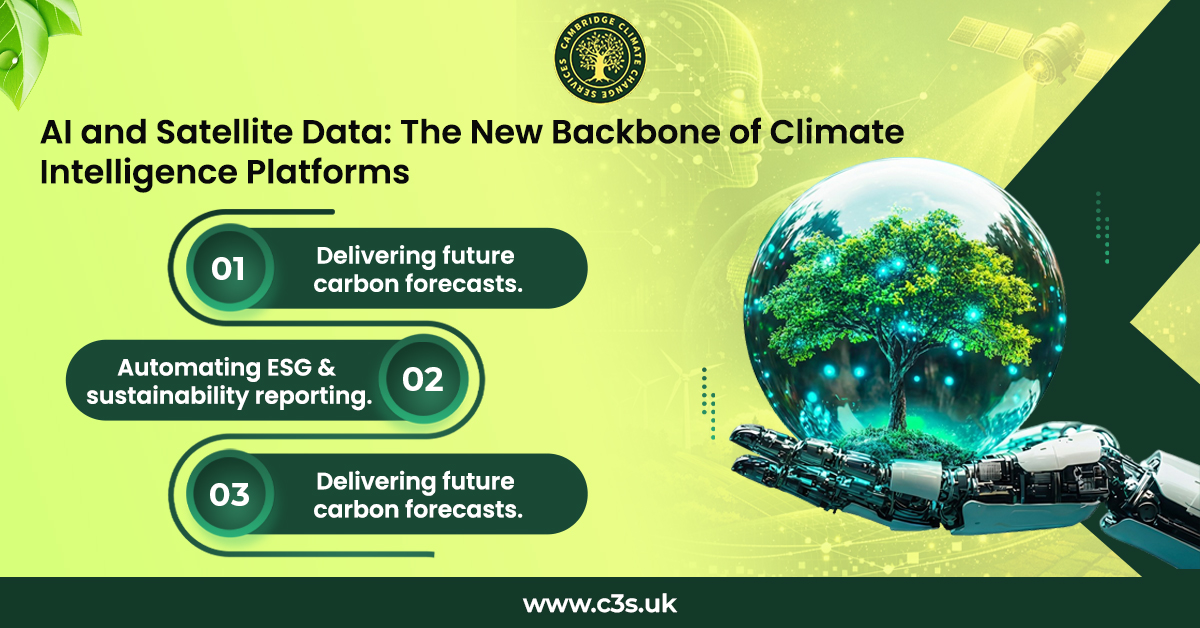
- Delivering future carbon forecasts.
- Estimating climate hazards related to exposure of tangible assets.
- Automating ESG and sustainability reporting.
- Driving strategic planning toward net-zero targets.
These kinds of insights offer considerable benefits to companies dealing with these two realities: ESG compliance and climate regulation disclosures. In those cases, data-centric reporting is becoming more and more necessary.
Conclusion
Embracing a data-driven future is no longer an option but a necessity for organizations that are committed to sustainability, resilience, and decarburization.
By partnering with AI experts in climate intelligence like C3S, businesses and governments can trust the AI climate strategies they develop and expedite these strategies, having gained confidence through the insights provided and assessments made by experts that are unimpeachable and forward-looking.









About Post Author