Climate Risk Assessments and Its Role in Corporate Strategy in the UK
With the climate crisis changing very fast, businesses are awakening to the urgency of aligning strategy with climate risks and sustainability opportunities. In the UK, climate risks assessments are now component of corporate strategy and with increasing mandates to conform to rigorous environmental, social and governance (ESG) criteria.
Such assessments are key for companies not only comply with regulations that will emerge, but more importantly, they also enable companies to ride the wave of compliance by being able to anticipate it and therefore turn risk into an opportunity for innovation and growth.
Key to this revolution is climate science. Businesses want pragmatic insights that can fuel both short-term resiliency and long-term sustainability. By uniting the latest in climate research with pragmatic, business-focused solutions, C3S helps businesses and other institutions prepare themselves for a changing climate and prosper in a low-carbon economy.
Understanding Climate Risk Assessments
Climate risk assessments involve the identification and evaluation of physical, transition and liability risks associated with climate change and developing management responses. These assessments typically focus on:
Physical Risks: These are related to the physical manifestations of climate change itself, for example extreme weather events (e.g. floods, heatwaves or storms picking up in frequency and intensity) or slow changes in climate patterns over time (e.g. sea level rise or temperature fluctuations).
For instance, companies located along a coast might have to evaluate risks from flooding and make investments in infrastructure that will stay upright when seas rise. For that climate risk assessment becomes even more important.
Transition Risks: The risk companies face when the world transitions to a lower-carbon economy, which can include changes in regulation, markets and technology. Transition risks may come from the requirement to adhere to policy such as UK net-zero targets, which may require substantial investment in new technology or business model.
Liability Risks: – These are primarily associated with legal action taken against a business influence on environmental degradation. More and more investors and consumers want companies to come clean about their climate risks, then act like they mean it.
The Role of Climate Risk in Corporate Strategy
Adding climate risk assessments to corporate strategy is no longer a luxury; it’s a necessity. With increasing investor and regulatory demands, and a more frequent occurrence of climate-related events, businesses need to act today to manage risks and make their operations future-proof.
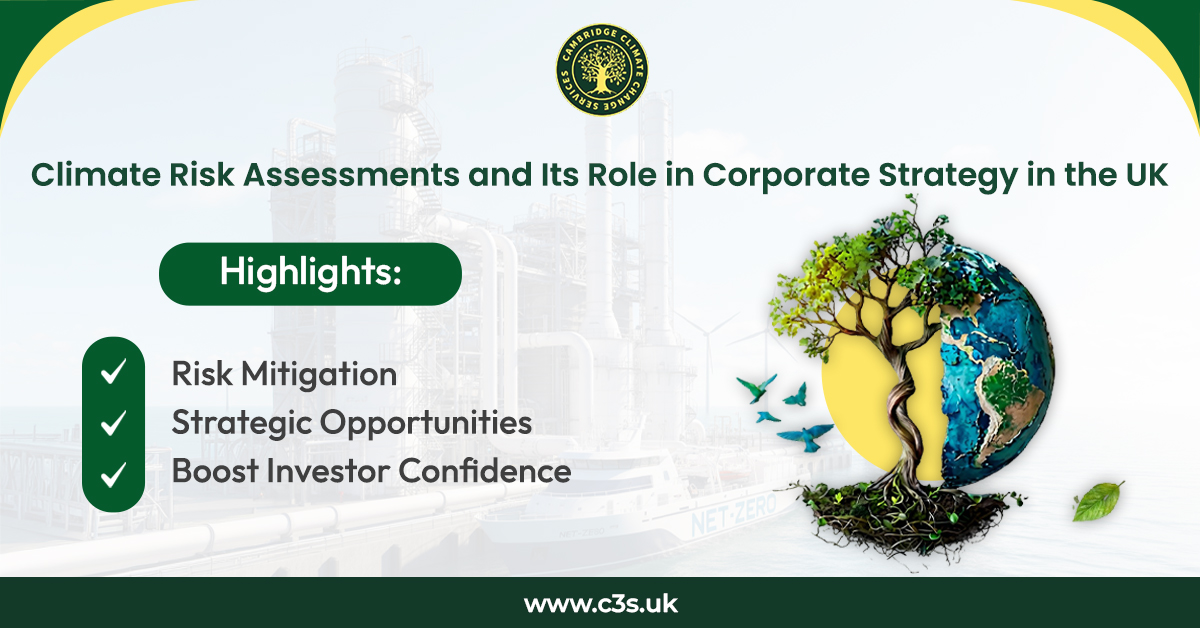
Risk Mitigation
Understanding potential climate risks—physical, transitional or liability spurs companies to act early so they can shield their assets and minimize long-term exposure. For example, companies may be required to put money into flood defences or diversify their sources of energy and production towards more sustainable methods.
Strategic Opportunities
Climate risk assessments also reveal opportunities for innovation. Companies which engage in green initiatives, including carbon offset projects or renewable energy investments, not only burnish their ESG credentials but the leaders in the green economy.
With powers in carbon strategy, renewable energy solutions (e.g. solar, biogas), and energy efficiency planning; C3S’s climate risk and resilience service is there to help businesses “convert” those opportunities into actual results.
Boost Investor Confidence
Sustainability and climate risk are increasingly at the core of decision-making in today’s investment world. The trust of investors is based in part on TCFD-aligned reporting, where investors can see and understand that a company is not only aware of climate risks but managing them proactively.
This creates increased confidence in investors and paves the way for new sources of funding, in particular in that sectors booming, namely green finance.
Resilience and Adaptation
Companies that integrate climate scenario analysis into their strategies can better navigate such uncertainties in the future. No matter whether it’s accommodating regulatory changes or shifting consumer preferences, and companies with a clear climate strategy become more resilient against these when confronted with climate challenges.
Conclusion
Climate risk assessment is a crucial element of UK corporate strategy. By incorporating climate risks into their decisionmaking, companies can secure the continuity of their operations and take advantage of new opportunities that arise from a sustainable future.
C3S is here to help businesses make the transition to a low carbon world by giving decision-makers “science-based business intelligence in making strategic, tactical and operational decisions that relate to climate”.









About Post Author