
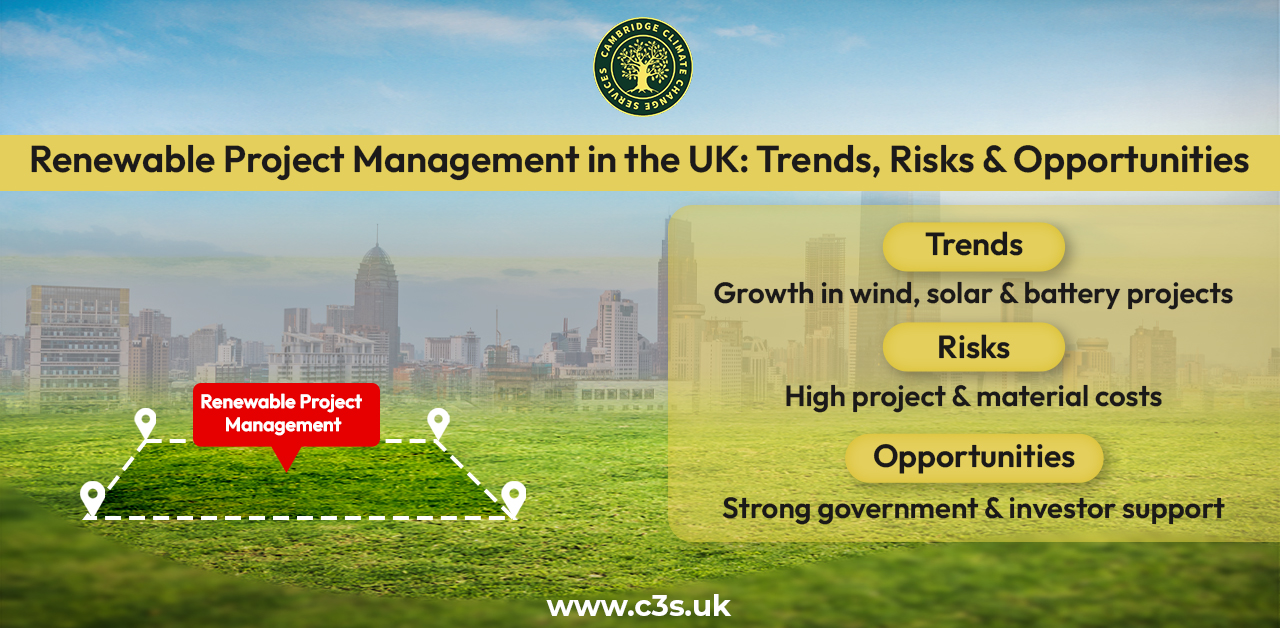
Renewable Project Management in the UK: Trends, Risks & Opportunities
The UK’s renewable energy space is experiencing a radical transformation. The change is due to ambitious climate targets, rapid technological change, and rising investor confidence. As the country approaches its net-zero goals, effective project management is increasingly an essential requirement to deliver renewable projects on wind, solar, hydro or battery storage. The project requires to be on time, on budget and with long-term sustainability.
Renewable Project Management is a field that has many new trends to develop into what new and changing markets will shape our economy. Understanding the future is one of the most vital aspects to developing developers, consultants, government bodies, and investors.
Trends in Renewal Project Management
Rapid Growth in Wind, Solar & Battery Storage Projects
The UK continues to lead Europe in offshore wind capacity, with new large-scale farms and repowering projects pushing capacity even further. Onshore wind and solar are also benefiting from better planning frameworks and lower technology costs.
Battery energy storage has become another important element as we have to balance the grid and support intermittent renewables. These developments will require project managers to apply integrated planning strategies that encompasses engineering, environmental approvals, stakeholder engagement, and digital monitoring.
Greater Emphasis on Sustainability & Compliance
Renewable projects are no longer just about providing clean energy. They must also satisfy strict environmental, social and governance (ESG) requirements. By this time, compliance with biodiversity protection, community engagement and land-use regulations are a pressing need.
Today’s project managers are expected to use impact assessments, carbon audits or sustainability goals from the beginning.
Use of Internet Services for Better Execution
Drones, GIS (geographic information systems), digital twins and AI forecasting are all re-shaping the practice of plotting and monitoring renewable projects. These devices eliminate project delays, improve safety and resources and therefore digital literacy is a necessity for contemporary project managers.
Risks in UK Renewable Project Management.
High Project and Material Prices
Renewable technologies are cheaper, but total project costs most notably for offshore wind and large-scale storage systems remain high. Costs of raw materials, such as steel, copper and rare earth metals, which fluctuate, are also a financial concern.
Infrastructure & Grid Restraints
Many renewable projects are stalled by lack of grid power, poor permitting and regional limitations. And the grid connections and lines There are ways in which renewable projects’ feasibility (the viability of renewable projects depends mostly on government policies, incentives and energy prices, incentives, pricing or pricing, and such is highly dependent on government policies, policies from the governments.
If a sudden change in policy suddenly occurs in the environment, it can have substantial impact on programme timelines or on investor trust and investor enthusiasm for your time frame or confidence. Planning permissions and environmental approvals also entail navigating the area of planning permissions and environmental approvals can be risky so you have to take careful risks.
Opportunities for the Future of Renewable Projects
Good Government & Investor Support
The UK government invests billions in contracts for difference (CfD), Renewable Energy Zones and research funding. Private equity and institutional investors too are placing greener portfolios at the top of their priority list. Such a powerful financial ecosystem supports project managers with the necessary resources to scale the renewable energy infrastructure.
A Growing Demography for Expert Renewables Project Managers
As project flows increase, so does the need for specialists in planning renewable projects, assessing risk involved between stakeholders, and overseeing all ecological processes. That opens up wide channels of career and business opportunities for consultants and engineering firms.
Growth into the World of Hybrid Energy Systems
Systems that integrate wind, solar, and battery are increasingly being used. With these combined solutions also reducing costs and ensuring more integrated solutions, greater efficiencies and better reliability, project developers can get a more consistent power flow through which to use as it comes to power generation, creating new, exciting options for project developers.
Conclusion
Renewable project management in the UK exists at a crossroads of innovation, investment and sustainability. Although high costs, regulatory complications and infrastructure limitations pose challenges, the trend for growth is robust.
These conditions are attractive, especially if the policy is in favor of the industry, as well as the presence of investors and high technological advances. For institutions working towards renewable energy development, good project management is the secret to turning future promises into tomorrow’s clean-energy future.









About Post Author