
Importance of Site Assessment and Solar Resource Mapping for Large-Scale Projects
As global energy increasingly relies on renewable resources now, solar energy is seen as the foundation for sustainable development. Large-scale solar projects are crucial to meeting ambitious climate goals. But with these projects their success depends mainly on careful design and execution—from preliminary site surveys to solar resource surveying all the way through to actual performance studies.
By employing the right process a safe system of operation is set up that not only maximizes the practical feasibility and economic attractiveness of installing the solar energy systems but also ensures they are long lasting in nature as well.
Solar Energy as a Key Part of Corporate Sustainability
Decreasing Greenhouse Emissions and Environmental Harm
Solar energy is a renewable energy that greatly reduces greenhouse gas emissions. Solar power assists organizations by replacing the energy from fossil fuel power (e.g. used by industries or commercial firms) which is still indirectly connected to their operational needs and can reduce their Scope 2 emissions.
Becoming Better at Corporate Social Responsibility (CSR)
Solar energy usage boosts an organization’s corporate social responsibility (CSR) profile by showcasing its commitment to sustainability and environmental protection. Moreover, companies integrating solar power with the firm’s operations will reduce its ecological footprint not only environmentally speaking but also are in line with expectations placed on us by eco-minded consumers, investors, and stakeholders.
Meeting Regulatory and Investor Expectations
Everywhere they look from a worldwide perspective, governments and regulatory bodies are becoming stricter in imposing environmental mandates on organisations, leading to the need for sustainability. Solar energy enables organizations to meet these regulations and also in the pursuit of investor’s demand for sustainability through social responsibility.
Multinational clients want suppliers to prove clean energy adoption as part of sustainability (the only way to build on a long-standing trend).
The Role of Site Assessment in Large-Scale Solar Projects
Site assessment for solar projects is systematic analysis of a location for the installation of solar cells. This procedure consists of analysis of solar irradiance, shading, and availability of land, orientation, electrical installation, and ecological compliance.
Other factors such as topography, soil stability, and community acceptance, are all more relevant to big projects. This assessment also underpins project planning and tries to find out if the project supports stakeholders in their decisions concerning system designing, installation cost as well as performance over time. Just as you wouldn’t build the house without checking the earth below, you shouldn’t install solar without knowing every factor that impacts performance,
Basic Elements of Site Assessment for Solar Projects
Solar Resource Evaluation and Irradiance Mapping
Energy is produced from solar radiation. Correct quantification of Global Horizontal Irradiance (GHI) and Direct Normal Irradiance (DNI) are essential to predict system performance.
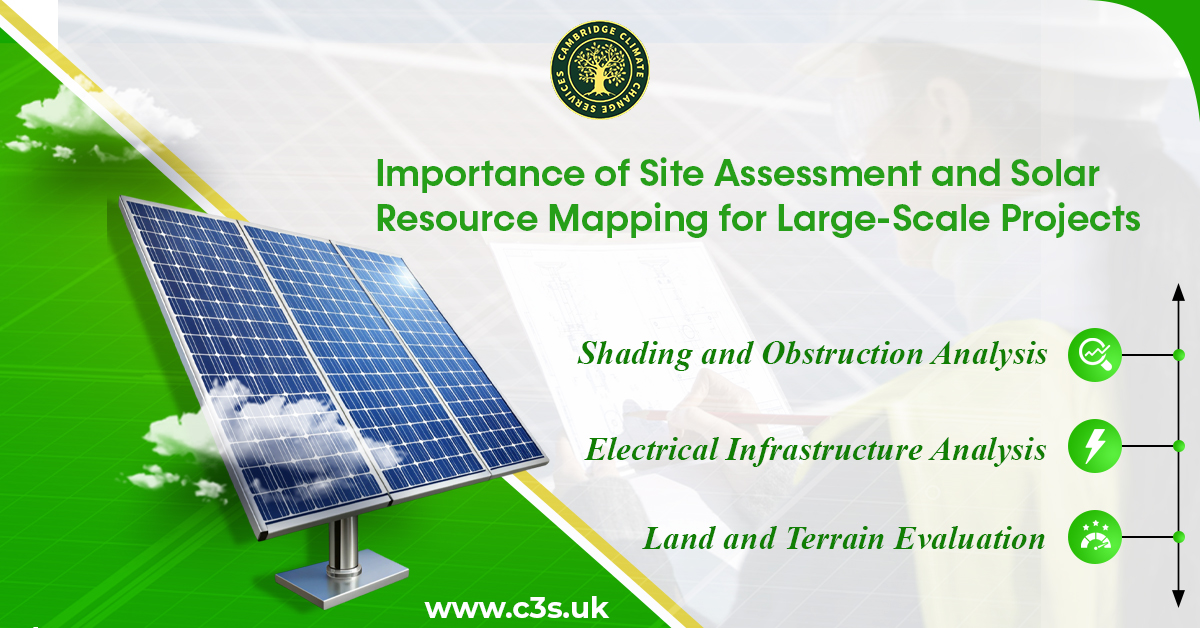
Shading and Obstruction Analysis– Solar system shading from trees, buildings and other structures can influence energy production immensely. Information from LiDAR and satellite imagery provides a detailed and meaningful view of shading patterns, where they can be deployed in optimal panels.
Land and Terrain Evaluation– For utility-oriented projects, land-condition such as topography, soil stability, and drainage are important. This terrain study is performed for a comprehensive site evaluation for solar projects to see if the ground can provide the infrastructure without high grading or foundation costs.
Electrical Infrastructure Analysis– The integration with the grid is a cost-effective option by the degree to which local infrastructure meets those services. Assessing substations, transmission lines, and grid interconnection points is an important part of the site investigation.
Conclusion
Solar projects, particularly on a large-scale, must comply with environmental laws and land-use policies. Evaluate potential local ecological impacts and navigate the legal and community opposition to zoning regulations that are necessary. Considering multiple benefits, site assessment for solar projects is must.









About Post Author