
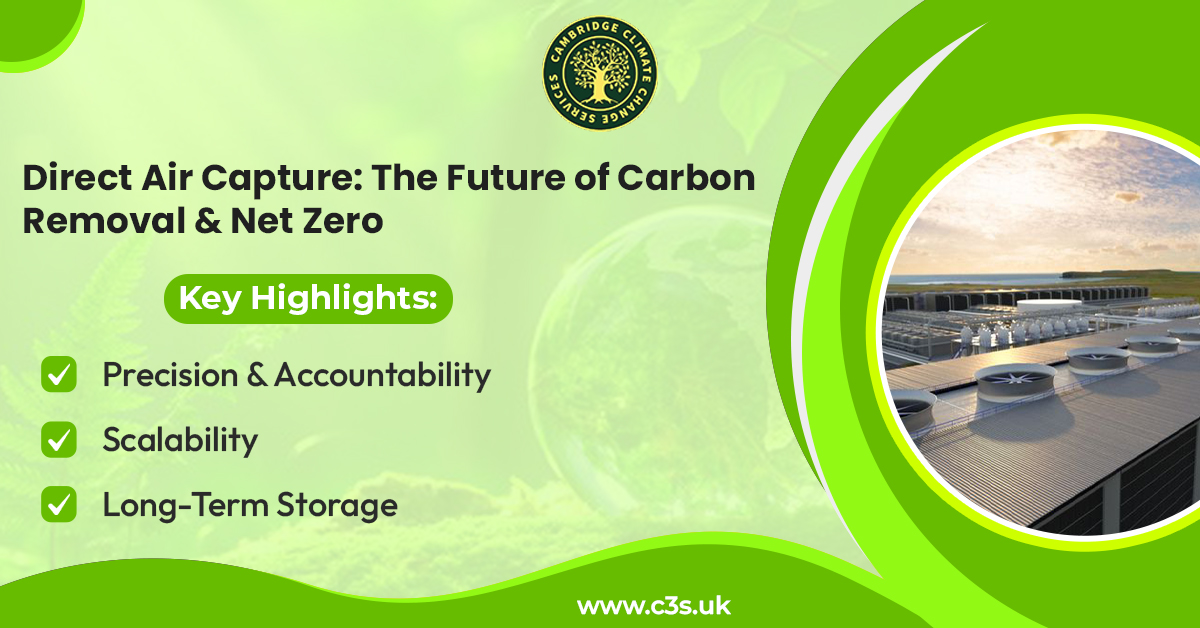
Direct Air Capture: The Future of Carbon Removal & Net Zero
Under the urgency of climate change, communities everywhere are suffering the devastating effects of the crisis from rising temperatures, severe storms, wildfires and flooding. Cutting greenhouse gas (GHG) emissions is by far still the top priority, yet global science is unequivocal:
To reach net-zero targets and stabilize the climate, the world needs to eliminate existing carbon dioxide from the atmosphere. This is where Direct Air Capture (DAC) stands as one of the most potential future-ready climate technologies.
What is Direct Air Capture?
Direct Air Capture is a process which extracts CO₂ directly from ambient air through specialized chemical reactions. As air passes over engineered sorbents or solvents, these materials preferentially bind with CO₂, isolating it from other gases. Once collected, heat or electricity is used to give off the CO₂ from the sorbent to help it be reused.
The captured CO₂ can have one of two pathways:
Permanent geological storage, where CO₂ is injected deep underground into suitable rock formations.
Utilization, in which CO₂ is converted into products, such as concrete, synthetic fuels or polymers. But it is only in permanent storage that the long-term climate benefits are guaranteed.
Of any individual system, solid sorbent DAC relies on renewable heat sources such as geothermal energy to achieve its optimum performance, while liquid solvent DAC generally requires higher temperatures and potentially higher energy use. New electrochemical DAC technologies have the potential to reduce the electrical energy demand in the future.
Global Growth in Direct Air Capture: From Concept to Deployment
For the past decade, director to air capture has evolved over time from an incubator to a very large, rapidly growing industry. By 2025, there are approximately 150 DAC-focused companies operating globally with dozens of plants at stages of deployment.
Countries like Canada, Japan, Kenya and several EU members are also taking the DAC curve in the form of policy incentives, mini-pilot projects and carbon credit purchasing programs.
The net-zero goal of the world does not only involve emission reduction but also entails taking measures that are hard to abate in other sectors: such as aviation, heavy industry, big transport and agriculture.
Advantages of Direct Air Capture
Precision & Accountability
DAC allows accurate measurement of how much CO₂ is removed, something natural climate solutions cannot always guarantee.
Scalability
Unlike forests or soil-based solutions, direct air capture is not constrained by land type or climate. DAC can be developed nearly anywhere with clean energy.
Long-Term Storage
DAC coupled with geological sequestration keeps carbon locked away for thousands of years, creating durable climate impact.
Challenges in Direct Air Capture: Cost, Energy & Community Concerns
Despite its potential, DAC does not come without serious challenges:
High Costs: DAC at present costs from $100 to $2,000 per ton, with companies targeting a rate of $100–$300 per ton over the next 10 years.
Energy Demand: Such large-scale direct air capture projects might require a lot of renewable power, which could also raise issues of land use and grid competition.
Local Impacts: Communities with DAC facilities may fear safety, water use and CO₂ pipelines.
To safely scale, robust regulations, open community involvement, and clean-energy DAC systems are required.
Conclusion
The Intergovernmental Panel on Climate Change (IPCC) estimates that by mid-century, billions of tons of carbon removal per year might be required. Direct air capture will not substitute for emission reduction, but can play a pivotal role in a diversified portfolio of climate solutions including (but not limited to) renewables, reforestation, soil carbon and green technologies.









About Post Author